 by
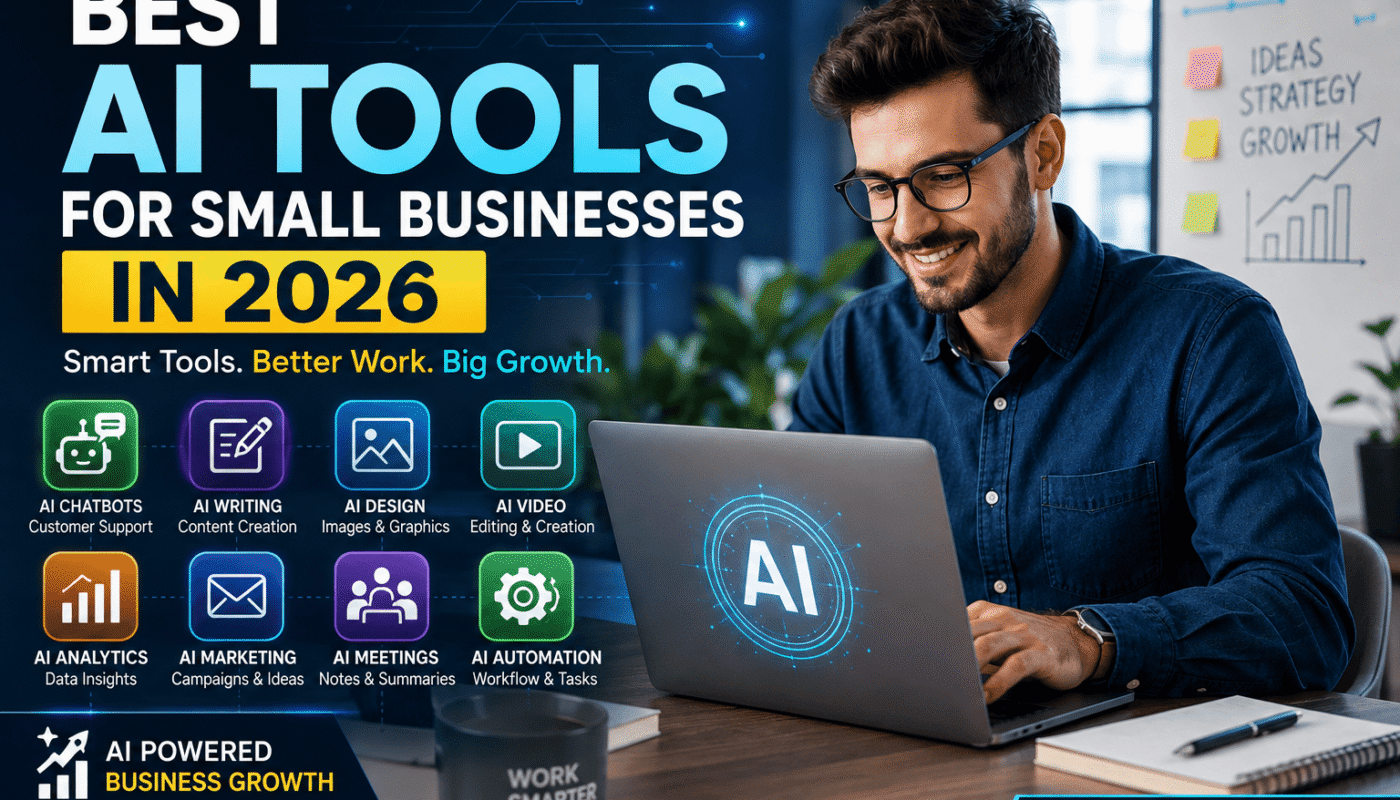
by Best AI Tools for Small Businesses in 2026
Artificial intelligence has become much more accessible to small businesses. Tools powered by AI can now help with content creation, customer support, marketing, research, productivity, design, and many other daily tasks.
For a small business, using the right AI tools can save time and reduce repetitive work. However, not every tool is suitable for every business. The best choice depends on your goals, budget, team size, and the type of work you need to automate or improve.
In this guide, we look at some useful categories of AI tools that small businesses can consider in 2026 and explain how they can fit into everyday business operations.
Why Should Small Businesses Use AI Tools?
Small businesses often operate with limited staff and resources. Business owners may have to manage marketing, customer communication, sales, administration, and content at the same time.
AI tools can assist with many of these tasks.
Some potential benefits include:
- Saving time on repetitive tasks
- Creating first drafts of content
- Improving customer communication
- Generating marketing ideas
- Analyzing information
- Creating images and designs
- Organizing business workflows
- Supporting research and planning
AI should generally be treated as an assistant rather than a complete replacement for human decision-making. Important business information should still be reviewed before it is published or used.
1. AI Writing and Research Tools
AI writing assistants can help small businesses create drafts for blog posts, product descriptions, emails, social media posts, advertisements, and other content.
They can also help with brainstorming topics, summarizing information, creating outlines, and improving existing text.
For example, a small online store could use an AI writing assistant to create an initial product description and then have a team member check the details before publishing it.
When using AI-generated content, businesses should verify facts, remove inaccurate information, and make sure the final content provides genuine value to customers.
2. AI Chatbots for Customer Support
Customer questions can take up a significant amount of time, particularly for businesses that receive similar questions repeatedly.
AI-powered chatbots can help answer common questions about products, services, opening hours, order processes, or basic policies.
A chatbot can be particularly useful outside normal business hours.
However, customers should have an easy way to contact a human when a question is complicated or requires personal assistance.
3. AI Design and Image Tools
Professional design can be expensive for a small business, especially when new graphics are needed regularly.
AI design and image-generation tools can help create concepts for:
- Social media graphics
- Blog illustrations
- Marketing materials
- Product concepts
- Presentations
- Promotional visuals
Businesses should carefully review generated images before using them commercially and check the terms and licensing conditions of the specific tool.
AI should also complement a consistent brand identity rather than producing completely different designs for every campaign.
4. AI Video Tools
Video marketing continues to be useful for businesses that want to reach audiences through platforms such as YouTube, Instagram, TikTok, and other social networks.
AI video tools can assist with tasks such as script preparation, captions, editing, voiceovers, and converting longer content into shorter clips.
For example, a business could turn a product demonstration into several short social media videos.
Human review is still important because AI-generated narration, captions, or visual elements may contain mistakes.
5. AI Meeting and Productivity Tools
Meetings can generate a lot of information that employees may need to remember later.
AI meeting assistants can help with tasks such as transcription, summaries, action items, and identifying important discussion points, depending on the features offered by the service.
This can help a small team spend less time manually writing notes.
Before recording meetings or processing customer information, businesses should also consider privacy requirements and obtain appropriate consent where necessary.
6. AI Marketing Tools
Marketing is another area where AI can assist small businesses.
AI-powered marketing platforms may help with:
- Content ideas
- Audience research
- Campaign planning
- Email drafts
- Ad copy
- Social media planning
- Performance analysis
For example, a local business could use AI to brainstorm several promotional ideas for an upcoming seasonal campaign.
The final marketing message should still reflect the company’s brand, audience, and actual products or services.
7. AI Analytics Tools
Understanding business data is important for making better decisions.
AI-powered analytics tools can help businesses identify patterns in sales, website traffic, customer behavior, and marketing performance.
Instead of manually reviewing large amounts of data, business owners may be able to use AI-assisted analysis to identify areas that deserve attention.
However, AI-generated insights should not automatically be treated as fact. Business owners should check the underlying data before making important financial or operational decisions.
8. AI Tools for Email and Communication
Email remains an important communication channel for many businesses.
AI assistants can help draft:
- Customer replies
- Follow-up emails
- Business proposals
- Newsletters
- Appointment messages
- Internal communications
This can save time when dealing with repetitive communication.
The best results usually come from giving the AI clear instructions and then reviewing the final message before sending it.
How to Choose the Right AI Tool
With hundreds of AI products available, choosing the right one can be difficult.
Start by identifying the actual problem you want to solve.
Ask yourself:
What task takes too much time?
Does the AI tool solve that specific problem?
Is the pricing reasonable for my business?
Does it integrate with the software I already use?
How does the provider handle my business data?
Can my team learn to use it easily?
A simple tool that solves one important problem may be more useful than an expensive platform filled with features your business never uses.
Are Free AI Tools Enough for Small Businesses?
Free AI tools can be useful for testing an idea or handling basic tasks. They allow small businesses to understand how AI fits into their workflow before spending money.
However, free plans may have limitations such as usage restrictions, fewer features, lower limits, or limited integrations.
If an AI tool consistently saves your team significant time or improves an important business process, a paid plan may be worth considering.
Always compare the current pricing and features before subscribing because AI services can change their plans over time.
Important Things to Consider Before Using AI
AI can be helpful, but businesses should use it responsibly.
Don’t enter confidential customer information, passwords, financial details, or other sensitive data into an AI service unless you have confirmed that the service’s privacy and security practices are appropriate for that information.
Also, don’t publish AI-generated information without checking it.
AI systems can sometimes produce incorrect facts, outdated information, or misleading statements. Human review remains especially important for financial, legal, medical, technical, and other sensitive business content.
Final Thoughts
The best AI tools for small businesses in 2026 are not necessarily the tools with the largest number of features. The right tool is one that solves a real business problem and provides enough value to justify its cost.
AI can assist with writing, research, customer support, design, video, marketing, productivity, and data analysis. Small businesses can start with one or two areas where they spend the most time and gradually expand their use of AI.
The most effective approach is to combine AI efficiency with human judgment. Use AI to handle repetitive work and generate ideas, while people remain responsible for accuracy, strategy, customer relationships, and important decisions.